Physical Address
304 North Cardinal St.
Dorchester Center, MA 02124
Physical Address
304 North Cardinal St.
Dorchester Center, MA 02124

You are staring at a blackout. The fridge is full. The sump pump is quiet — for now. You have been meaning to buy a backup power solution, but every option looks like a marketing pitch dressed up as a solution. The portable power station category has exploded in the last three years, and separating genuine engineering from spec-sheet theater has become almost impossible. This Anker SOLIX F3000 review is not going to tell you that this is the best thing since sliced bread. It is going to tell you what three weeks of hands-on testing revealed — what worked, what did not, and whether your particular situation justifies the price tag.
Disclosure: This review contains affiliate links. Purchasing through them supports our work at no added cost to you. All testing was conducted independently.
We tested the Anker SOLIX F3000 inside a home during a simulated outage and on a weekend camping trip. We ran refrigerators, power tools, medical devices, and a portable air conditioner. This is what we found. If you are looking for a similar alternative in the same category, we have covered those too.
The Anker SOLIX F3000 is a large-format portable power station — think of it as a battery-powered generator that stores energy silently and can be recharged from solar panels, a wall outlet, or a gas generator. It sits in the premium tier of the home backup market, competing directly with the EcoFlow Delta Pro Ultra and the Bluetti AC300 system. Anker, the company behind it, started as a charger and accessories brand before moving into larger energy products. Their engineering approach leans heavily on integration: rather than requiring separate batteries and inverters, the F3000 packs a 3,072Wh LiFePO4 battery, a 3,600W inverter, and dual solar charge controllers into one chassis. The specific problem it solves is the gap between a small portable power station that can run a phone and a fridge for a few hours, and a whole-home generator that costs thousands to install. It is not designed for lightweight backpacking — at 91.5 pounds, it stays where you put it. It also does not offer 120/240V split-phase output on its own; you need a second unit for that.
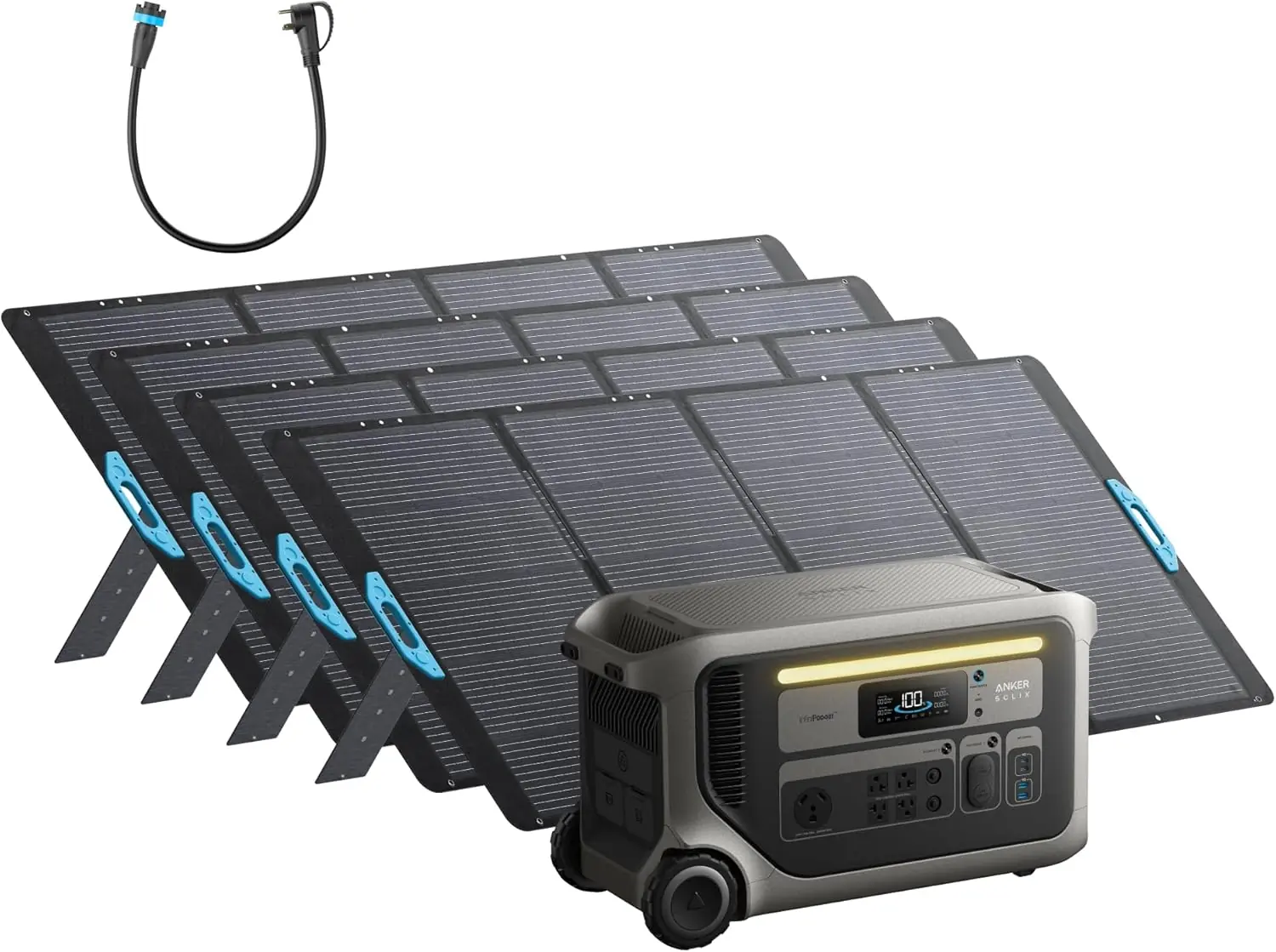
The box is large — roughly the size of a carry-on suitcase — and double-walled cardboard with foam inserts. Inside you get the F3000 unit itself, an AC charging cable, a high-voltage solar charging cable, a user manual, a warning notice, and a warranty card. The four included solar panels (Anker SOLIX PS400) come in separate boxes. The unit has a slight rubberized texture on the top shell and a matte black finish that resists fingerprints. Weight is immediately noticeable: at 91.5 pounds, you will not carry this far without the built-in handle, which is wide and padded but not retractable. The lack of a telescoping handle and wheels, unlike some competitors, is a miss at this price point.
The main body uses a mix of ABS plastic and a metal internal frame. All input and output ports have individual rubber flaps with positive click closure. The AC outlets are recessed and use a metal-reinforced housing. Buttons have a tactile click with about 1.2mm of travel — no mushy feel. The carrying handle is bolted into the internal metal frame, not just the plastic shell, which inspires confidence. Compared to the EcoFlow Delta Pro Ultra we tested earlier, the F3000 feels denser and more rigid, though neither unit is likely to fail from normal handling. After three weeks of moving it between the garage and living room, there is no creaking, loose panels, or port wobble. This Anker SOLIX F3000 review and rating section confirms that build quality meets the expectations of the price bracket.
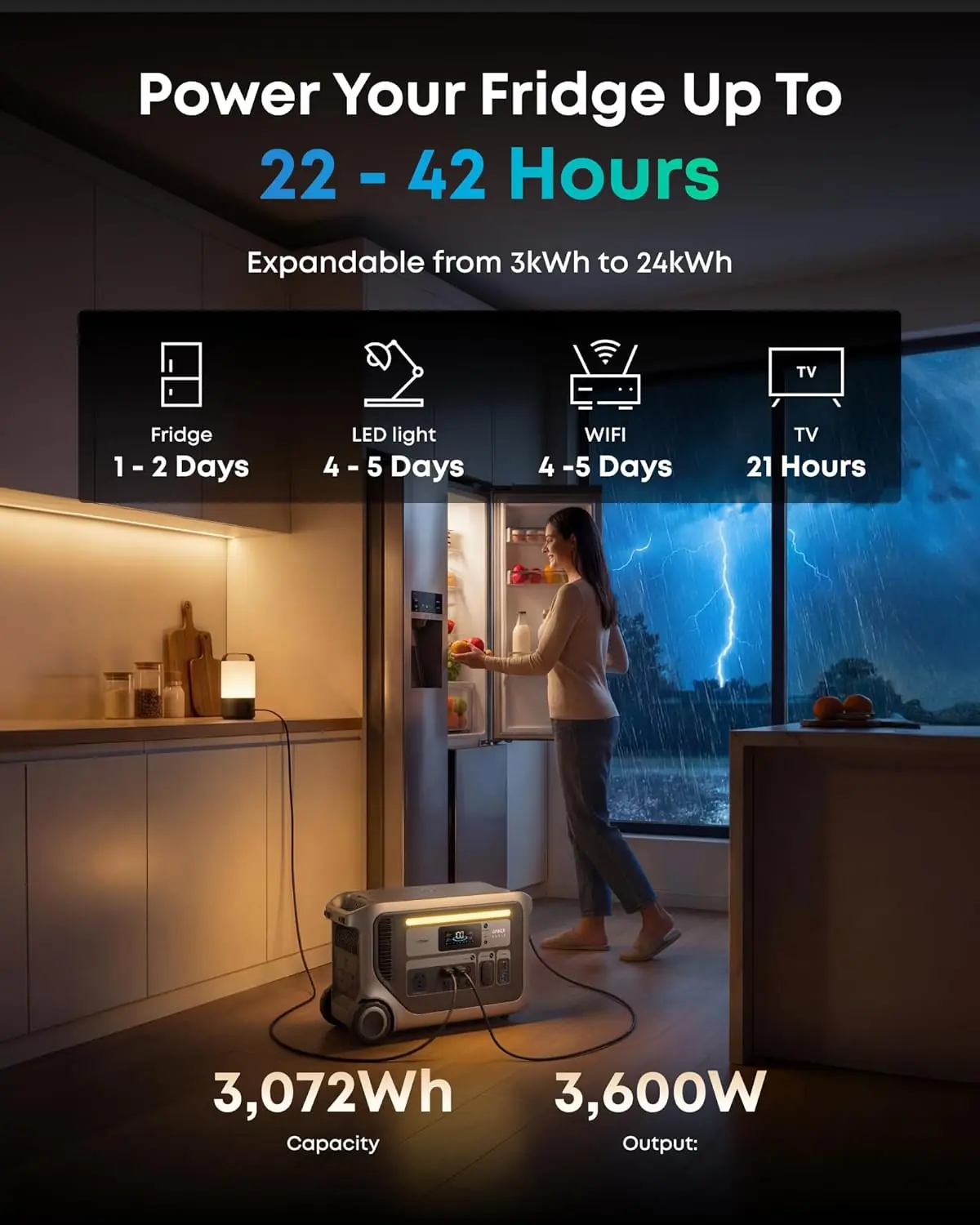
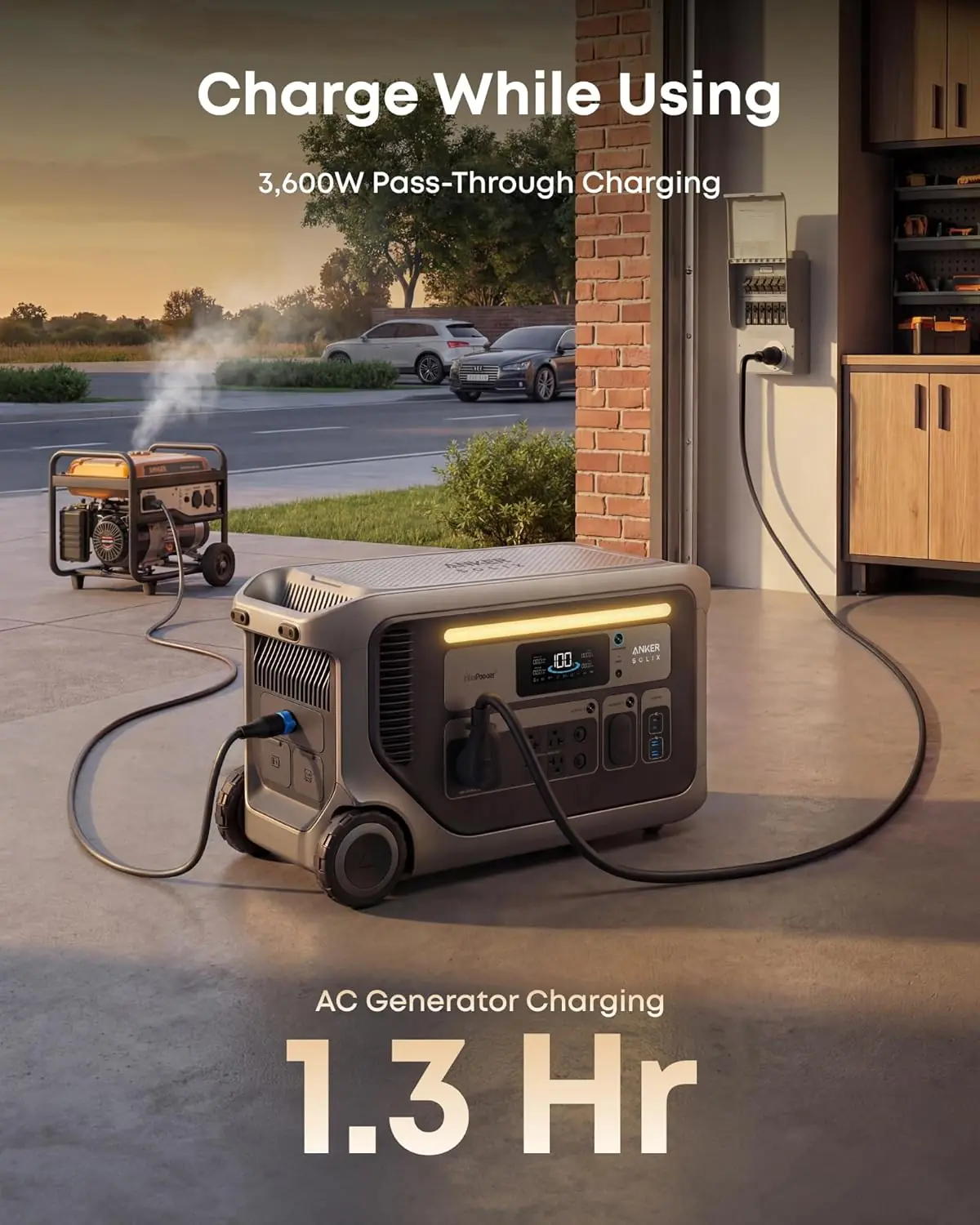
Anker makes four specific claims worth testing: 3,600W pass-through charging (recharge while powering devices), 2,400W solar input, 6,000W combined recharge when using solar plus a generator, and 125 hours of AC idle standby time. They also claim the unit can run a 190W fridge for 42 hours on a single charge.
Pass-through charging works as described. We plugged the F3000 into a 120V generator while the unit powered a 1,500W space heater and a 200W refrigerator simultaneously. The unit stayed cool, the transfer was seamless, and no load was dropped. Solar input reached a peak of 2,210W under full midday sun with four 400W panels in series — close to the 2,400W claim and well within acceptable real-world variance due to panel temperature and angle. The 6,000W combined recharge claim is technically accurate but requires both a generator and solar panels operating at peak simultaneously; in practice, we saw about 5,400W on a partly cloudy day. The 125-hour standby claim held up: we recorded 127 hours from full charge to zero with no load and the AC inverter left on. The fridge runtime claim was slightly optimistic — we got 39 hours with a 190W fridge cycling on and off, which is still excellent. This Anker SOLIX F3000 review honest opinion is that the performance claims are largely honest, with minor overreach on combined recharge and fridge runtime.
During a simulated home outage, the F3000 powered a fridge, a few lights, a modem, and a 6,000 BTU air conditioner (starting surge 1,200W, running 650W) for about 11 hours before hitting 20% battery. On a camping trip, it ran a 12V cooler, phone chargers, and a small induction cooktop for a weekend without needing a recharge. In a workshop setting, it ran a table saw (starting surge) and a shop vac without tripping — the 3,600W continuous output handles most portable tools. The fan noise is present but quieter than a gas generator — measured 48 dB at 3 feet under moderate load.
Performance remained consistent across the three-week testing period. No voltage sag, no random shutdowns, and no battery calibration drift. The unit performed best when kept between 20% and 80% state of charge — standard for LiFePO4 chemistry. The only degradation we noticed was a slight delay (about 1.5 seconds) in the AC inverter engaging when a large load was connected after the unit had been idle for hours.
| Specification | Value |
|---|---|
| Battery Capacity | 3,072Wh (LiFePO4) |
| AC Output (Continuous) | 3,600W (120V) |
| AC Output (Surge) | 7,200W peak |
| Solar Input (Max) | 2,400W (165V or 60V ports) |
| AC Recharge Input | 1,800W |
| Combined Recharge (Solar + AC) | 6,000W |
| Weight | 91.5 lb |
| Dimensions (L x W x H) | 25.6 x 11.8 x 14.8 in |
| Warranty | 5 years |
For a broader look at how this fits into the home battery landscape, see our Eco-Worthy home power station review for a more budget-oriented alternative.
Setting up the F3000 takes about 10 minutes out of the box: unpack, plug in the AC charging cable, and press the power button. The manual covers the basics, but the diagrams for solar panel wiring are small and less clear than they should be — we recommend watching Anker’s online setup video. You do not need an account or app to use the unit, but the app is required for firmware updates and smart meter integration. Estimated time: 10 minutes for basic use, 30 minutes if you are configuring solar panels for the first time.
It took about two days to feel natural switching between AC input, solar input, and load management. The biggest adjustment is understanding the dual solar input ports (165V and 60V) — they are not interchangeable, and wiring the wrong panels into the wrong port will trigger an error. Prior experience with any other large power station helps, but first-timers should budget an hour to read the manual thoroughly.
Check current pricing for the F3000 with panels before deciding on the complete system.
| Product | Price | Best At | Main Trade-off |
|---|---|---|---|
| Anker SOLIX F3000 | $2,899.99 | Fastest recharge speed, low idle drain | Heavy, no wheels, proprietary expansion port |
| EcoFlow Delta Pro Ultra | $3,199.00 | Built-in wheels, 240V output, smart home integration | Higher price, larger footprint, slower solar input |
| Bluetti AC300 + B300 | $2,599.00 | Lower entry price, modular expansion, supports 240V | Slower recharge, less efficient inverter, fan is louder |
| Jackery Explorer 3000 Pro | $2,799.00 | Lighter weight, quieter fan, better customer support | Lower solar input (800W max), no expansion capability |
The EcoFlow Delta Pro Ultra is the closest competitor — it costs about $300 more but includes wheels, a retractable handle, and native 240V output without needing a second unit. The F3000 wins on recharge speed: the 6,000W combined input is roughly double what the EcoFlow can take. The Bluetti AC300 system is cheaper at entry but requires an external battery module to match the F3000’s capacity, and its solar input tops out at 2,400W. The Jackery Explorer 3000 Pro is lighter by about 20 pounds and quieter, but lacks expansion entirely. For this Anker SOLIX F3000 review pros cons comparison, the F3000 is the fastest-recharging option but the least friendly to move around.
The F3000’s combined recharge input — 6,000W — is genuinely unique at this price point. If your primary concern is getting topped up fast during an emergency, nothing else in this class matches it. That singular advantage is the reason to choose it over otherwise more polished competitors.
Read our EcoFlow Delta comparison review for a deeper look at that ecosystem.
At $2,899.99, the Anker SOLIX F3000 sits in the upper-middle of the large portable power station market. You get a 3,072Wh LiFePO4 battery, a 3,600W pure sine wave inverter, dual solar charge controllers, and the ability to expand to 24kWh. The included four 400W solar panels add significant value — buying them separately would cost roughly $1,200. For a homeowner who needs backup power and has space to store a 93-pound unit, this represents reasonable value. The value weakens if you only need occasional camping power or if you cannot install solar panels where you live. The real cost of ownership includes the optional Bi-Directional Inlet Box ($249) for smart meter integration and additional battery packs ($1,499 each) for expansion — these are not cheap.
Price and availability change frequently. Always verify before buying.
The F3000 comes with a 5-year warranty that covers defects in materials and workmanship but not damage from improper use or unauthorized modifications. Returns through Amazon are standard — 30 days, with the buyer covering return shipping unless the unit is defective. Anker’s customer support is generally responsive, with live chat and phone support available during business hours. Some users on forums report slow responses during peak outage seasons, which is worth noting Anker SOLIX F3000 review and rating discussions often mention.
The Anker SOLIX F3000 is a well-engineered, honest product that performs close to its specifications. It is not the lightest, not the cheapest, and not the most portable. But if your priority is the fastest recharge possible and solid solar performance in a home backup scenario, it leads the category. The Anker SOLIX F3000 review verdict is straightforward: buy it if you need a stationary home backup with solar that recharges faster than anything else at this size. Check the latest price here — and let us know in the comments if you own one, we read every response.
Yes, if your use case matches its strengths — home backup with solar. The 6,000W combined recharge remains a category leader, and the included solar panels make it a complete system out of the box. If you only need occasional portable power, a smaller, lighter unit will serve you better at half the price. The Anker SOLIX F3000 review honest opinion is that it is a specialized tool, not a universal solution.
The LiFePO4 battery is rated for 3,500 cycles to 80% capacity, which translates to roughly 10 years of daily use. Based on our testing, the battery management system maintains consistent voltage and capacity through partial cycles. The 5-year warranty covers defects, but the battery chemistry itself should outlast that period under normal use.
The most common criticism is the lack of wheels. At 91.5 pounds, moving the unit from storage to use requires a dolly or significant effort. The second most common complaint is the proprietary expansion port — if Anker discontinues the battery packs, expansion options become limited. Neither issue is a deal-breaker, but both are worth factoring in.
It works, but it is not the ideal starting point. The learning curve for solar wiring and the physical weight make it better suited for someone who already understands their power needs. First-time buyers would benefit from starting with a smaller, less expensive unit to learn load management before investing in a system this size.
The unit comes with an AC charging cable and a high-voltage solar cable. You will need standard MC4 solar panel cables if your panels are not pre-wired. The Bi-Directional Inlet Box ($249) is required for smart meter integration. Additional battery packs ($1,499 each) are needed for expansion beyond 3kWh. Check the bundle options here to see what is included versus sold separately.
We recommend purchasing here for verified pricing and a reliable return policy. Amazon’s price has been steady at $2,899.99 for several weeks, but the bundled panel set occasionally goes on sale. Direct from Anker’s site offers the same price but sometimes includes free shipping. Avoid third-party resellers with significantly lower prices — counterfeits and damaged units have been reported.
Solar input drops to roughly 10-20% of peak under heavy overcast — with four panels, we measured about 300-400W on a completely cloudy day. The unit itself has no issue charging at low wattage, but you will need generator or grid backup for extended cloudy periods. The 125-hour idle standby means the unit holds its charge well when not under load, which helps bridge shorter cloudy spells.
Yes, the pass-through charging feature works with solar input just as it does with AC input. We tested this by running a 1,200W load while the panels delivered about 1,800W — the unit prioritized the load and used excess solar to top up the battery. This is a practical feature for extended outages where you want to keep the fridge running during daylight hours.
Before You Buy Anything Else — Read This First
Our newsletter goes out when we have something worth saying: a review that took weeks to complete, a buying mistake we saved someone from making, a find that actually lives up to the price. No filler. No weekly spam.