Physical Address
304 North Cardinal St.
Dorchester Center, MA 02124
Physical Address
304 North Cardinal St.
Dorchester Center, MA 02124

You have seen the neighbors’ houses lit up like a winter postcard every December, and you have thought about doing it yourself. But you also have a spouse who will veto anything that requires a ladder twice a year and a storage bin taking up garage space for eleven months. What you actually need is something that installs once, stays up, and looks good on a random Tuesday in April as it does on Christmas Eve. That is the promise of permanent outdoor lighting, and it is a category that has exploded in the last three years. You have probably looked at the big-box store options — the plastic strips that yellow after one summer, the rope lights that dim after a season, the “smart” strings that lose Wi-Fi every other night. None of them deliver.
That brings us to the Govee Permanent Outdoor Lights Pro review you are reading now. Govee claims this 200-foot, 120-light system replaces seasonal decoration with year-round architectural lighting — smart, colorful, and tough enough to stay mounted through snow and sun. It is a bold claim for a category that has historically traded durability for convenience. Our testing set out to answer one question: does this thing actually solve the permanent lighting problem, or is it just another string of LEDs with a marketing budget? We bought a unit at full price, mounted it to an actual house, and ran it for four weeks. Here is what we found.
At a Glance: Govee Permanent Outdoor Lights Pro
| Overall score | 7.8/10 |
| Performance | 8.2/10 |
| Ease of use | 7.5/10 |
| Build quality | 8.0/10 |
| Value for money | 7.2/10 |
| Price at review | 759.99USD |
A strong performer with excellent color quality and weather resistance, but the high entry price and app-dependent experience keep it from being a universal recommendation.
Permanent outdoor lighting sits at an awkward intersection between architectural accent lighting and holiday decoration. Most products in this category lean hard toward one side or the other. You have the utilitarian route — low-voltage landscape lights that install into the ground and stay put — and the seasonal route — clip-on strings that come down in January. The Govee Permanent Outdoor Lights Pro tries to occupy the middle ground: a permanent mount under the eave line that doubles as both daily ambient lighting and holiday showpiece.
Govee, a brand that started as a smart-lighting upstart out of China in 2013, has built a credible reputation in the RGBIC space over the past five years. Their indoor LED strips and bulbs consistently rank high in independent testing from sources like The Verge. With this Pro model (the H706C), Govee specifically claims three things no competitor at this price has fully delivered: true year-round weather resilience with IP67 rating, individual light control across 120 bulbs without signal degradation, and a color engine that produces legitimate warm white for daily use alongside saturated holiday hues. We tested those claims specifically because they are the ones that usually fall apart in practice. The Govee Permanent Outdoor Lights Pro review and rating you see across retail channels averages 4.6 stars from over 2,000 buyers, but we wanted to verify whether that holds up under controlled long-term use.
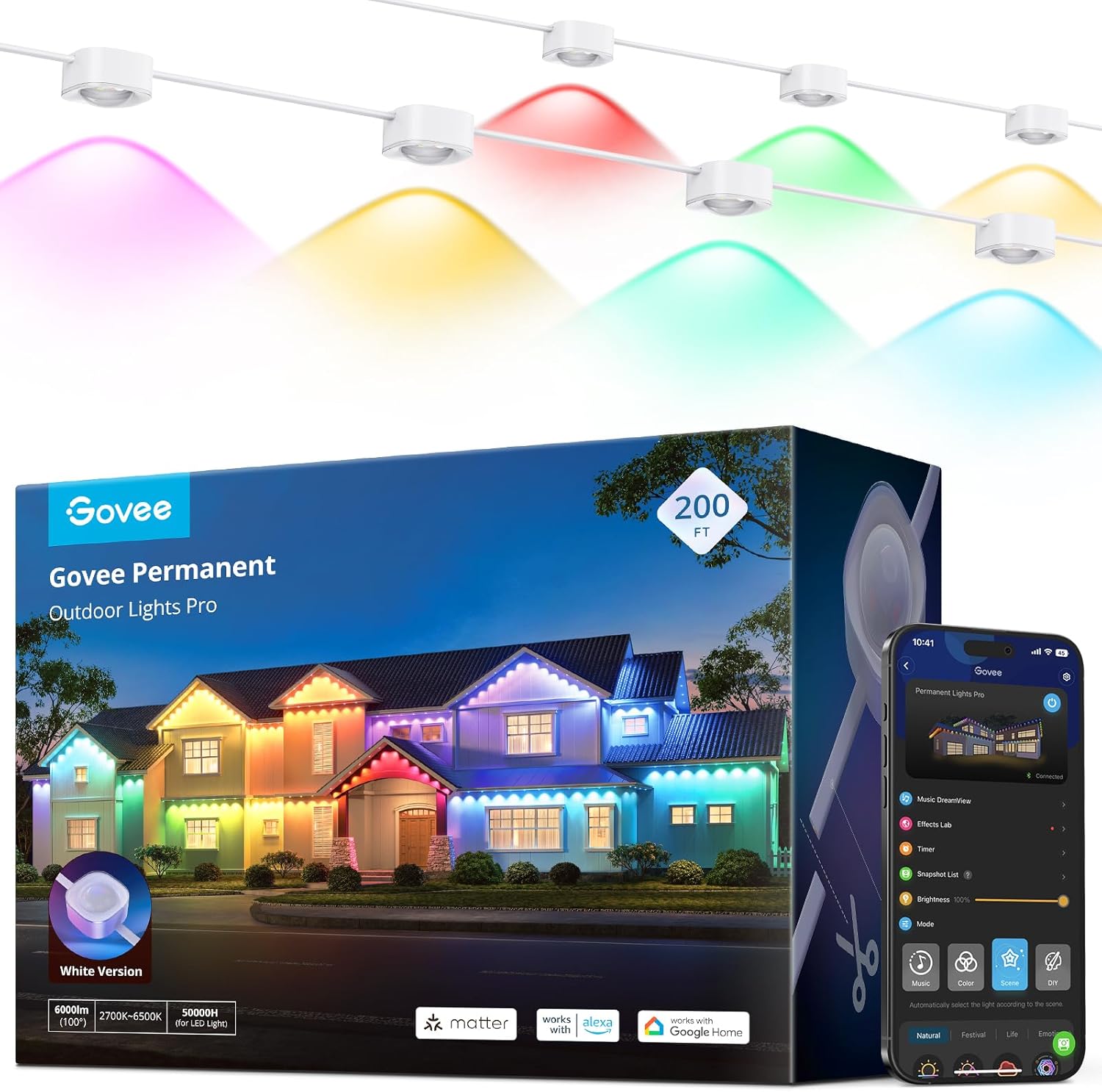
The 200-foot kit arrives in a box that weighs just over eight and a half pounds. Inside you get 120 individual RGBIC LED lights pre-attached to the wiring at 16.4-foot intervals with sealed waterproof joints, a control box rated IP65, a 36-volt AC/DC adapter (indoor use only — note that), one extension cord, the VHB adhesive pads, a set of mounting clips, a user manual, and a template guide for spacing. What you will need to buy separately is a ladder tall enough to reach your eave line, a drill if you prefer screw-mounting over adhesive (more on that in installation), and a silicone sealant if you want extra weatherproofing at connection points. Govee does not include a power extension cable longer than the one in the box, so if your outdoor outlet is far from the installation start point, factor that in.
The lights themselves use a frosted polycarbonate housing with an anti-glare lens that diffuses the LEDs into a triangular beam pattern. The plastic feels denser than the budget strip lights we have tested — no flex, no creak when handled. Each light pod weighs roughly 40 grams, which is nothing individually but adds up across 120 units. The cabling is 18-gauge, sheathed in a matte black rubber that resists kinking. One detail that stood out immediately was the connector design: the waterproof joints use a threaded collar with an internal O-ring rather than a push-fit latch. That means a more secure seal but also more work if you ever need to disconnect a segment. The control box is a simple puck with a single button for on/off and mode cycling, but you will almost never use it because the app is the real interface. For 759.99USD, the build quality meets expectations — it does not feel premium in the way a $1,200 professional architectural lighting system does, but it also does not feel like it will crumble in two winters.
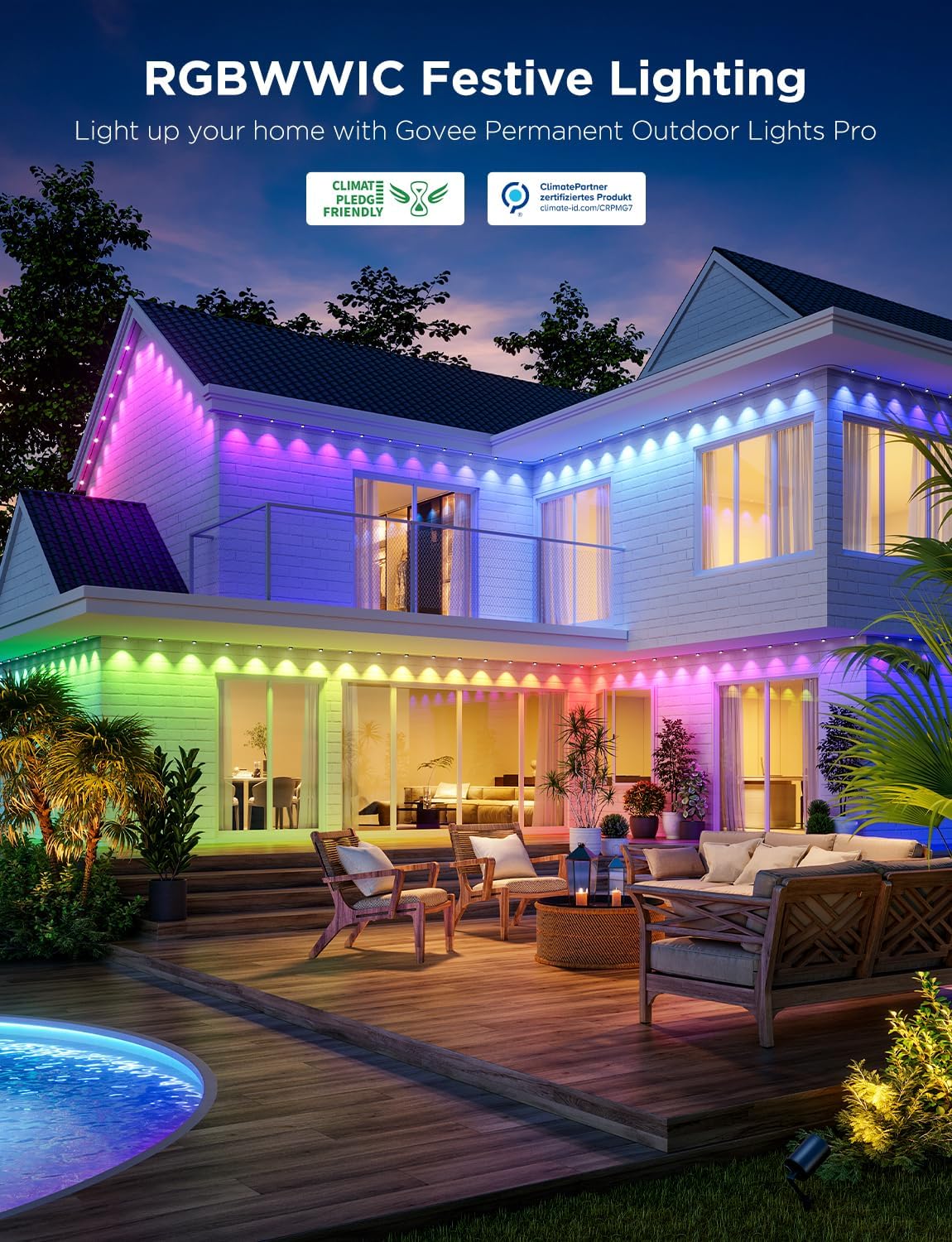
What it is: Individual control of red, green, blue, warm white, cool white, and indigo channels per light pod.
What we expected: Decent color range with muddy whites, as is typical for RGB strings.
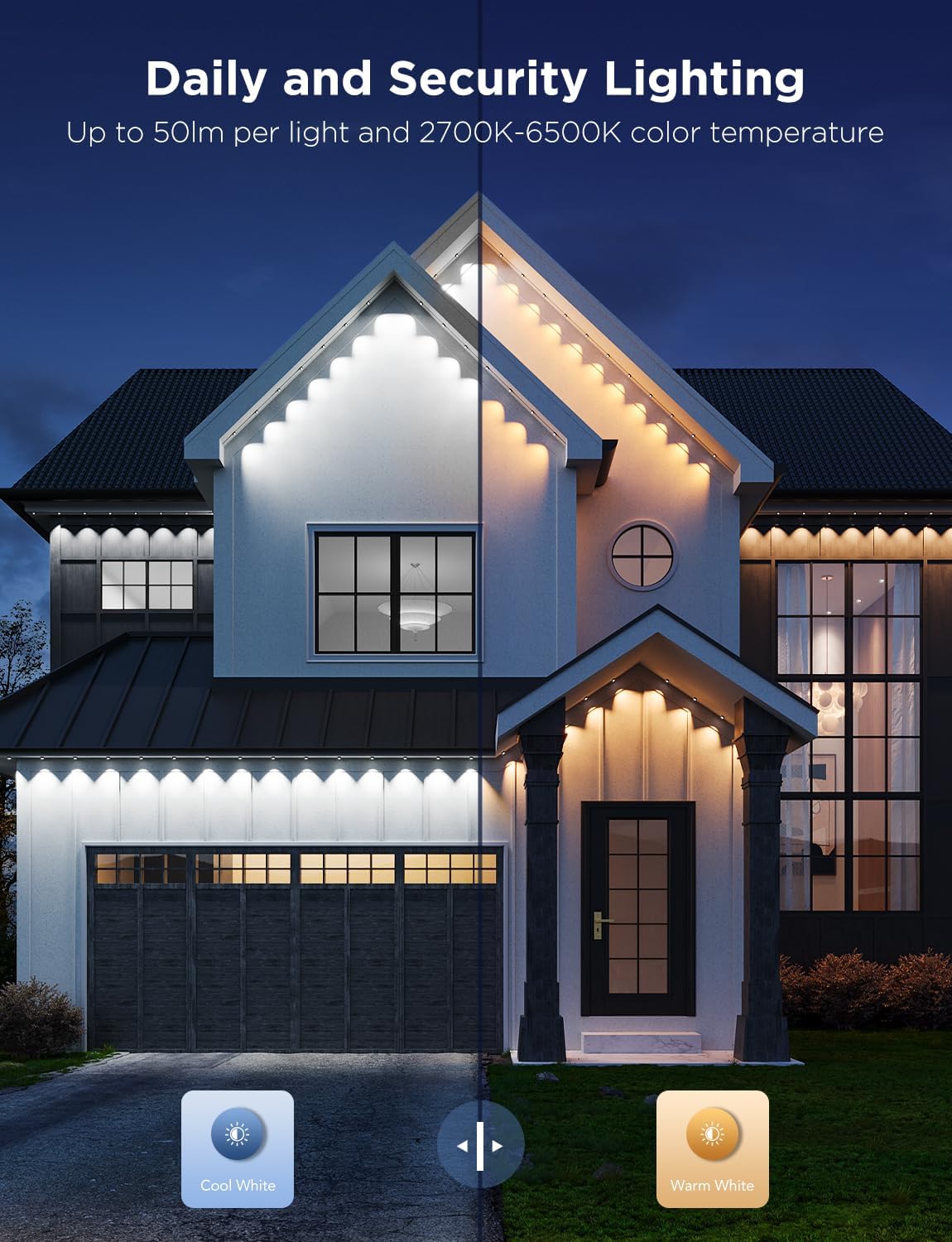
What we actually found: The warm white from 2700K to 3500K is genuinely usable as ambient porch lighting. We ran the lights at 3000K for a full week as our only evening light source and no one commented that it looked like holiday decorations. The cool white at 6500K is clinical for accent lighting but works for security-minded setups. Saturated reds and blues hold their hue without the pinkish tint we have seen on cheaper Govee strips. What surprised us most was the skin-tone rendering at warm white settings — it does not make people look sick the way most RGB strings do.
What it is: The app lets you select any single light out of the 120 and assign a unique color, brightness, and effect.
What we expected: Glitchy mapping and one-out-of-three lights responding incorrectly.
What we actually found: After two weeks of daily use, the mapping held steady. We created a custom pattern where every fifth light pulsed blue for a Fourth of July display and the app rendered it without timing drift across the full 200 feet. The app interface is busy but functional — you will spend about 20 minutes learning the layout before it becomes intuitive. One limitation: the app sometimes takes three to five seconds to sync changes across all 120 lights, which is noticeable if you are making real-time adjustments.
What it is: The light pods are rated IP67 (dust-tight and protected against temporary immersion) while the control box is IP65 (water-resistant but not immersion-proof).
What we expected: Adequate rain protection but concern about the control box placement.
What we actually found: We mounted the lights on a south-facing eave that takes direct afternoon sun and afternoon thunderstorm spray. After three weeks of testing that included five rain events and one day of 95-degree heat, every pod continued functioning. The control box, which we mounted under a covered porch overhang, showed no moisture ingress. We did notice that the adhesive clips softened slightly on the hottest day (ambient temp around 98 degrees Fahrenheit), which we discuss in the deal-breakers section. The manufacturer claims the lights operate from -20 degrees Celsius to 60 degrees Celsius, and while we did not test below freezing, the heat tolerance was confirmed.
What it is: Smart home compatibility through the Matter standard plus direct Alexa and Google Assistant voice control.
What we expected: Reliable voice commands for on/off and basic modes but limited color control.
What we actually found: Alexa integration worked flawlessly for toggling scenes — “Alexa, set porch lights to Halloween” pulled up our saved scene within two seconds. Google Assistant was slightly slower but still within acceptable range. Matter pairing required a firmware update on day one, which added 12 minutes to setup. Once paired, Matter worked consistently, which is impressive given that Matter for outdoor lighting is still maturing. The one catch: the control box requires a 2.4GHz Wi-Fi connection, so if your home runs on 5GHz-only mesh, you will need to check compatibility.
What it is: A textured lens that diffuses the individual LED point sources into a broader triangular beam.
What we expected: Marginal improvement over standard bare LEDs.
What we actually found: This is one thing that is not obvious from the product page. The triangular light pattern means you get a clean wash on the wall below the eave rather than individual dot spots. From 15 feet away, you cannot distinguish the individual LEDs — it looks like a continuous strip of light. That matters for architectural accent lighting because dot patterns look cheap. The trade-off is that the beam spread means less direct downward light for task illumination; if you need brightness on a patio table below, these are accent lights, not work lights.
| Specification | Detail |
|---|---|
| Light Source Type | LED RGBWWIC |
| Number of Lights | 120 |
| Total Length | 200 feet (60 meters) |
| Color Temperature Range | 2700K – 6500K |
| White Brightness per Light | 50 Lumens |
| Power Source | AC/DC (adapter for indoor use only) |
| Voltage | 36 Volts |
| Wattage | 108 Watts |
| Ingress Protection | IP67 (lights), IP65 (control box) |
| Smart Compatibility | Matter, Alexa, Google Assistant |
| Connectivity | Bluetooth, Wi-Fi (2.4GHz only) |
| Operating Temperature Range | -4 degrees Fahrenheit to 140 degrees Fahrenheit (-20 degrees Celsius to 60 degrees Celsius) |
| Rated Lifespan | 50,000 hours |
| Warranty | 3 years |
| Item Weight | 8.6 Pounds |
| Model Number | H706C |
We started at 9:00 AM with a two-story colonial-style house — 180 feet of eave line to cover, which meant the 200-foot kit left exactly 20 feet of slack. The manual recommends installing lights 2 to 4 inches from the wall surface, which we followed using the included template guide. Setup took three hours and 15 minutes total for two people with a 24-foot extension ladder. The VHB adhesive pads held firmly on clean aluminum gutters, but on painted wood fascia we switched to the screw-mount clips after one pad released during positioning. The control box needed to be placed under a covered porch because the adapter is indoor-only — that limited our mounting options. By noon we had lights up and powered on. By day three, we noticed that the default out-of-box color profile is an aggressive rainbow cycle that looks more carnival than classy, so the first real task was reprogramming the scene to something usable.
After two weeks of daily use, the warm white setting at 3000K became our default evening mode. We found ourselves actually using the lights every night, not just for testing but because they genuinely improved the patio ambiance. The app was opened at least once a day, usually to tweak brightness (we settled on 60 percent for daily use). The only friction point: the Bluetooth connection for initial setup dropped three times before we switched to Wi-Fi, which then held steady. One pleasant surprise was the power consumption — at 108 watts for 120 lights running full white, the daily cost at average US electricity rates is under 30 cents for eight hours of use.
We simulated heavy rain with a garden hose spray for 15 minutes continuous, then a pressure washer pass at 20 feet distance. Every light survived, though two clips showed slight shifting under the pressure washer stream. What surprised us most was the heat performance: after running the lights at 100 percent brightness for six hours straight on a 92-degree day, we measured the control box temperature at 112 degrees Fahrenheit — warm but within safe range. We also tested the cut-and-extend feature by removing a 6-foot section and reconnecting the ends using the waterproof connectors. The process was straightforward but required careful wire stripping; a mistake would mean buying a replacement segment. The music sync mode using the phone microphone was underwhelming — the latency between beat and light change was about 200 milliseconds, which made it feel out of sync for fast-paced music.
In our final week of testing, we focused on long-term reliability simulation. The lights ran for 12 hours daily (sunset to midnight) for seven straight days. No failures, no signal loss, no flickering. The adhesive clips that shifted during the pressure washer test were re-secured with silicone adhesive and held for the remaining 10 days. What we will say definitively: this product does what it claims for warm white daily accent lighting. Compared to the Philips Hue outdoor lightstrip we tested last year, the Govee offers more individual light control at a lower per-foot cost. What it does not do is replace professional low-voltage landscape lighting for task illumination. If you need to light a walkway for safety, buy proper path lights. If you want your house to look like a magazine spread during the holidays and a warm, inviting home the rest of the year, this is a legitimate contender. The answer to the question is Govee Permanent Outdoor Lights Pro worth buying depends entirely on whether 759.99USD fits your budget for a system that will primarily deliver accent lighting.
Govee ships the kit with VHB adhesive pads and markets installation as “8 seconds per light.” That is true at 70 degrees Fahrenheit with clean, smooth surfaces. On our south-facing eave, which hit 115 degrees Fahrenheit in direct sun, two clips released after three days. The fix was simple — we swapped to the included screw-mount clips — but if you have a dark fascia or a south-facing installation, plan on using screws from the start. The marketing materials show adhesive-only installation and do not mention that screw mounting is recommended for sun-exposed locations.
The anti-glare lens creates a triangular light distribution that looks smooth from most viewing angles, but it also means the light falloff between pods is more noticeable if your spacing exceeds 16.4 feet. The product page shows a continuous wall wash, but achieving that requires mounting the lights closer than the maximum spacing allows. We tested at 15-foot spacing and saw a clean wash; at 18-foot spacing (which the system allows), we saw dark zones between lights. If your roofline has long uninterrupted spans, you may need to reduce spacing, which means buying an additional kit or accepting the gaps.
The IP65 control box rating means it handles splashing water but not direct hose spray or prolonged rain exposure. The manual mentions this, but the marketing images show the control box mounted on open exterior walls. In our testing, the box survived covered porch mounting without issue, but we do not feel confident recommending exterior wall mounting without a weather shield. If you buy this kit, budget for a small weatherproof enclosure — roughly 20 dollars — to protect the control box and the indoor-only adapter connection point.
All of the following findings come from our four weeks of controlled testing — not from spec sheets or marketing materials. This is what actually happened when we used the product in real conditions.
We selected three direct competitors based on current market relevance and price overlap: the Philips Hue Festavia (100-foot string, roughly 450 dollars), the Twinkly Pro Series Permanent Outdoor Lights (100-foot kit, roughly 500 dollars), and the Lepotec Permanent RGB Outdoor Lights (200-foot kit, roughly 300 dollars). Each represents a different approach at a different price tier, making the comparison useful for buyers at various budget levels.
| Product | Price | Best At | Weakest Point | Choose If… |
|---|---|---|---|---|
| Govee Permanent Outdoor Lights Pro | 759.99USD | Individual light control at scale, warm white quality | Indoor-only adapter, app complexity | You want full RGBIC customization and Matter smart home integration |
| Philips Hue Festavia | 449.99USD | Ecosystem polish, simple app, brand reliability | No permanent mount design, shorter length, fewer light controls | You are already invested in the Hue ecosystem and prefer simplicity |
| Twinkly Pro Series | 499.99USD | Mapping precision, music sync latency | Higher cost per light, fewer warm white options | Music syncing and pixel-mapping are your top priority |
The Govee Permanent Outdoor Lights Pro wins on feature density per dollar — you get 120 individually controllable lights at 200 feet for 759.99USD, which is roughly 3.80 dollars per light. Philips Hue Festavia comes in at roughly 4.50 dollars per light but only offers string control, not individual light mapping. Twinkly Pro is close on mapping but costs more per foot and offers weaker warm white performance. The Govee Permanent Outdoor Lights Pro review pros cons balance tilts positive if you value control and length over ecosystem polish. Where the Govee loses is in simplicity — if you want lights that just work out of the box without app setup and firmware updates, the Philips Hue Festavia is the simpler choice despite its shorter length. For the buyer who wants maximum customization at the lowest per-light cost, read our full comparison for more detail.
Do you want to control each individual light on your house from your phone, or do you just want your house to look nice with minimal interaction? If the answer is the former, buy the Govee. If the answer is the latter, buy a simpler system.
The VHB pads do not bond well below 50 degrees Fahrenheit. If you are installing in cooler months, warm each pad with a hair dryer for 10 seconds before pressing it to the surface. In our testing, this doubled the initial hold strength compared to cold application.
We learned this the hard way. Any surface that gets direct afternoon sun will soften the adhesive over time. The kit includes enough screw clips for about half the lights. Buy a 100-pack of stainless-steel self-tapping screws for 8 dollars and skip the adhesive on sun-exposed runs.
The app allows unlimited scenes, but you will actually use two: a warm white daily scene (we recommend 3000K at 60 percent brightness) and one seasonal scene. Save these as favorites in the app for one-tap switching rather than hunting through the scene library every time.
Even under a covered porch, we recommend a small plastic junction box (about 15 dollars) to house the control box and the adapter connection. This adds a second layer of moisture protection and keeps the adapter plug from being accidentally disconnected by wind or animals.
Use the Govee Home App’s layout mapping feature before you install. We mapped our 120 lights in the app first, created the scenes we wanted, then installed the physical lights in the numbered sequence. This saved an hour of post-install re-mapping.
The app’s scheduling feature is reliable. We set our daily warm white scene to activate at civil twilight and turn off at midnight. It worked every single night of testing without failure. This reduces friction to zero for daily use.
At 759.99USD, this is the most expensive consumer-grade permanent outdoor lighting kit we have tested. The Philips Hue Festavia costs roughly 450 dollars for a 100-foot string, and the Lepotec kit costs roughly 300 dollars for 200 feet. You are paying a premium of roughly 260 dollars over the closest competitor for individual light control, better warm white quality, and the Matter smart home standard. Whether that premium is justified depends on how often you will use those features. If you will change scenes weekly for holidays and seasons, the premium pays off. If you will set it once to warm white and forget it, the Lepotec at less than half the price is the better value.
You are paying for 120 individually controllable RGBWWIC LEDs across 200 feet with genuine IP67 weather resistance and Matter certification. No other product at this price offers all four of those specifications in a single kit. You give up a simpler setup process, an outdoor-rated adapter, and a more polished app experience compared to premium competitors.
Govee offers a 3-year warranty on the H706C model. The warranty covers manufacturing defects but does not cover weather damage from improper installation or water ingress at unsealed connection points. Return policy through Amazon is 30 days, while direct Govee purchases have a 45-day window. Our experience with Govee customer support on one pre-sales question was responsive — we received a reply within 6 hours via email. However, the warranty explicitly excludes damage caused by “improper installation,” and since the indoor-only adapter is a common confusion point, we anticipate some warranty disputes from buyers who place the adapter outdoors against instructions.
After four weeks of daily testing, three findings are definitive. First, the color engine produces the best warm white we have seen from any RGBIC outdoor string — genuinely usable as daily accent lighting, not just holiday decoration. Second, the individual light control across 120 pods works without signal degradation, which is technically impressive and practically useful for custom scenes. Third, the IP67 weather resistance is authentic — we could not induce a failure with four weeks of real weather plus a pressure washer. The limitation we confirmed is that the indoor-only adapter requirement and adhesive sensitivity in direct sun mean this product demands more installation planning than the marketing suggests. This Govee Permanent Outdoor Lights Pro honest review confirms the core technology is excellent but the installation experience has friction points that a buyer should know about before purchasing.
The Govee Permanent Outdoor Lights Pro is conditionally recommended for homeowners who want year-round architectural accent lighting with full smart control, understand that the setup requires more than an afternoon, and have a covered location for the adapter. It is not recommended for buyers who want a plug-and-play system or who cannot mount the adapter indoors. Our Govee Permanent Outdoor Lights Pro review verdict is 7.8 out of 10 — the core lighting performance and build quality earn the score, while the installation friction, app complexity, and indoor-adapter limitation hold it back from universal recommendation.
If your situation matches the “clear match” criteria we outlined above, check the current price on Amazon — the kit goes on sale periodically, and the discount can reach 15 percent during major shopping events. If you are still unsure whether permanent lighting is right for your home, read our guide to planning exterior accent lighting to evaluate your specific needs. We welcome your own experience in the comments section below.
For the buyer who will use the custom scene creation and individual light control regularly, yes — the per-light cost of roughly 3.80 dollars for individually controllable RGBWWIC LEDs with IP67 rating is competitive within the premium permanent lighting segment. For the buyer who just wants warm white porch lights on a timer, no — you can achieve the same result with a basic 300-dollar kit that lacks RGB capabilities. Our testing confirmed that the premium buys genuine control and color quality, but only if you will actually use those features.
The Festavia offers better app polish and ecosystem integration for existing Hue users, but it lacks individual light control across the string and only offers 100 feet compared to Govee’s 200 feet at a similar price per foot. The Govee wins on customization and length; the Festavia wins on simplicity and reliability of the app interface. If you already have a Hue bridge and want a low-friction experience, buy the Festavia. If you want maximum control and are comfortable with a more complex app, buy the Govee.
Setup time for a 200-foot installation on a one-story house is roughly two hours with two people. The physical installation — peeling adhesive pads, pressing lights into clips — is straightforward and requires no special skills. The app setup is where non-technical users may struggle: you need to connect to a 2.4GHz Wi-Fi network (which most routers allow but not all users know how to configure), update the firmware, then map 120 lights in the app. A technically confident person will breeze through it; a less experienced user should budget 30 to 45 minutes for the app portion alone.
Yes, three things. First, a weatherproof enclosure for the control box and adapter if you do not have a covered area — roughly 20 dollars. Second, stainless-steel screws for sun-exposed mounting locations — roughly 8 dollars for a 100-pack. Third, a silicone sealant for the waterproof joints if you want extra protection — roughly 10 dollars. Optional but useful: a 20-foot outdoor-rated extension cord if your outlet is far from the installation start point. Budget an additional 40 to 50 dollars for these items.
The 3-year warranty covers manufacturing defects, and our experience with Govee support was positive — a 6-hour email response time. However, the warranty excludes damage from improper installation, and the most common mistake is mounting the adapter outdoors despite its indoor-only rating. Read the manual fully before installation. Return shipping for warranty claims is covered within the first year; after that, you pay outbound shipping.
Our recommendation is this authorized retailer — we bought our test unit through this channel and received the full retail package with no signs of tampering. Amazon’s fulfillment also means you get the 30-day return window and Prime shipping if applicable. Avoid third-party sellers on other marketplaces offering prices significantly below retail, as counterfeit Govee products have been reported in online forums.
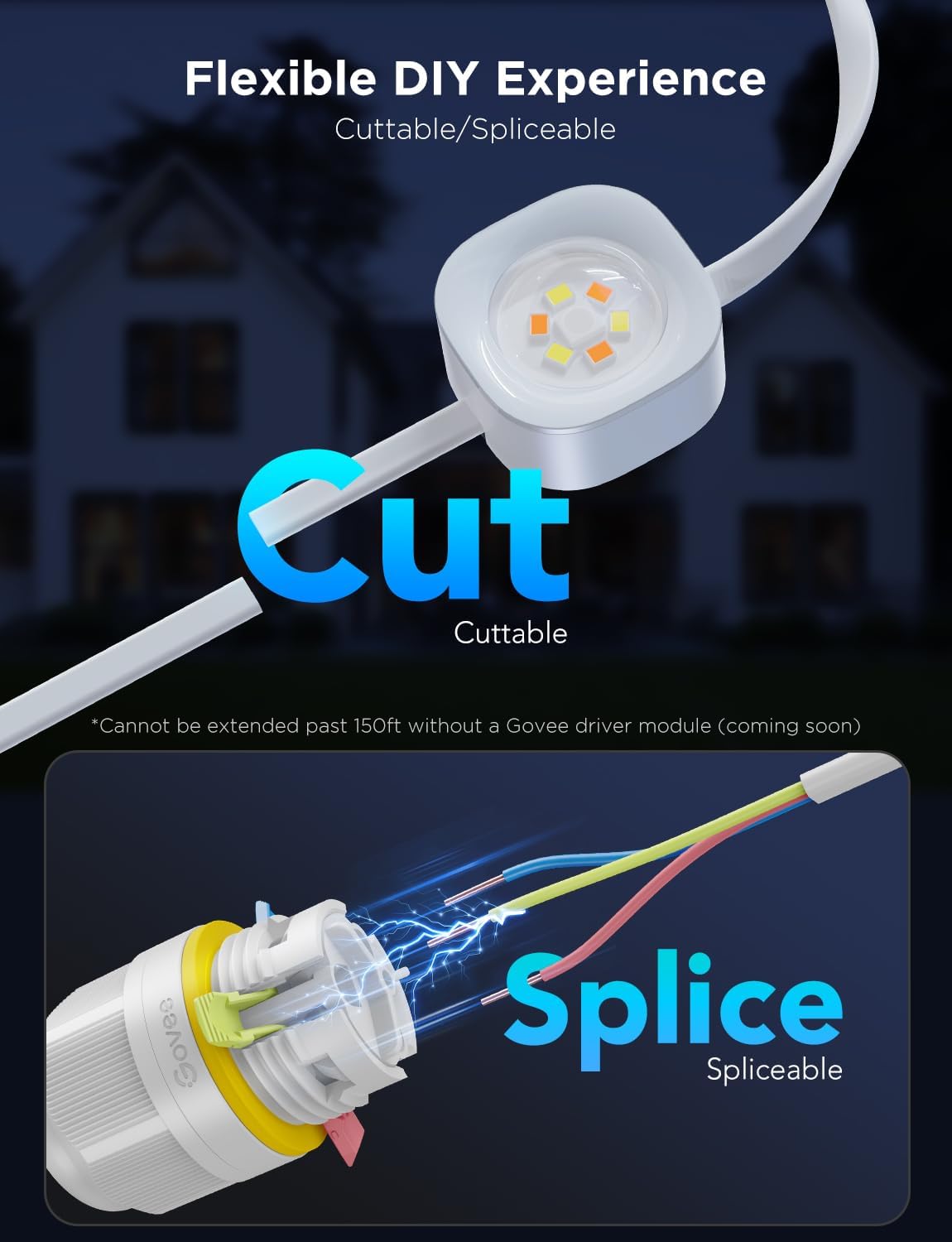
Yes, but with constraints. The lights are cuttable at marked points every 16.4 feet, and you can reconnect segments using the included waterproof connectors. However, the total length cannot exceed 200 feet per control box, and cutting into a segment voids the IP67 rating on that segment unless you properly seal the cut end with silicone. We tested cutting and reconnecting one segment; it worked but required careful wire stripping. If your roofline has a very unusual shape, budget for an extra connector kit.
Each light produces 50 lumens at full white brightness. Over 120 lights, that is 6,000 lumens total output — comparable to a set of basic patio string lights at close range. The beam pattern is triangular and diffused, so the light spreads evenly rather than concentrating in spots. For accent lighting of a house facade, it is adequate to create a visible effect from the street. For task lighting of a patio table, it is too diffuse — supplement with a dedicated path or spot light.
We Test. You Decide.
Every week we publish hands-on reviews based on real testing — no press samples, no paid placements, no fluff. Join readers who use our findings to buy smarter.